
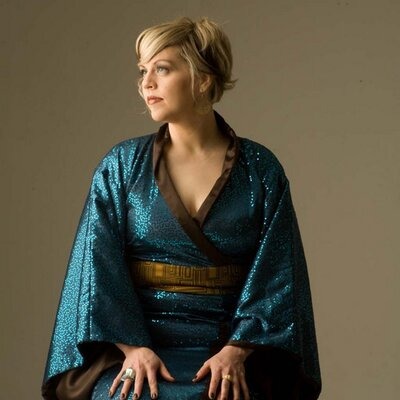
By Arthur Hatton
Linescratchers’ second interview from over the oceans, the articulate, passionate KaRyn Daley is a breath of fresh air in the acoustic scene. The folk/jazz/acoustic scene can be so oversaturated with blandness, and trapped in its own laziness, that when you find a musician like KaRyn, something truly fresh and unique, it’s almost jarring.

Her lyrics are amazingly honest. Her melodies are perfectly simple, but are ornately decorated with her stellar but raw vocals. KaRyn has a rapturous, sometimes subtle but controlled vibrato, and a dark, soothing tone. But believe it or not, she’s a soprano. She is currently teaching music in Seoul, but she has taken time from her schedule to do this interview.
How did your parents encourage you to play and sing? Tell us about growing up with music.
My Dad is a guitarist and avid music appreciator, so I grew up listening to Kiss, Black Sabbath, and The Cars and a lot of blues. Some people had bookshelves in their house crammed with, well, books. But I had shelf after shelf of records still carefully preserved in their plastic. Men At Work, Devo, U2, Cyndi Lauper. We moved a lot so keeping that many records in mint condition was no small feat.
I have so many memories that revolve around music, most of them silly – like jumping around to Loverboy’s “Everybody’s Working For The Weekend,” getting in trouble for making the record skip, trying to watch Kids Incorporated while my Dad plugged into his tower of Ampeg amps and sang blues songs at us when we complained. I remember getting all A’s in 5th grade and being rewarded with “any record that isn’t Madonna.”
As a family, we sang together all the time. Creating harmony was really important to us, and my 6 siblings and I were always writing songs or retuning familiar ones. I think songwriting was also just part of the Daley family curriculum. My Dad always wrote silly songs that we would learn and perform. I was never interested in the guitar, though. I started taking piano lessons at 12 years old and was always more interested in singing and writing than actually playing an instrument. I remember embarrassing myself at more than one baptism/family reunion/anniversary party by offering a cheesy piano song a la Michael McLean, but without a very good piano part. It’s only been in the last few years that I’ve discovered what my Dad already knew: the guitar is the perfect songwriting tool for cheaters.

What musicians influenced your music? Any musical heroes?
My vocal quality is heavily influenced by the blues and rock I grew up with. Even when I think I’ve created something a little off that path, my voice seems to bring it back in. I learned to sing from Whitney Houston (not literally, but you know, 500 repetitions of any album will make you feel like a friend). I’ve always identified with R&B vocalizations and really found my match in jazz in my college years. As a vocalist, I admire Nina Simone, Aretha Franklin, Jay Clifford (of Jump Little Children) and Dolly Parton. As a songwriter, I’m always in love with Elvis Costello, Jonatha Brooke, Ryan Adams and Aimee Mann, and currently in love with everyone else. My first songwriting attempts at 14 were blatant rip-offs of Tori Amos songs. And of course, my aunt Pat Folkner and my father, Mike O’Daly, both musicians and songwriters, are probably my strongest influences.
You’ve mentioned that you love musical theater. Any favorites?
Musical theater is where it all started for me. I’m currently listening to a lot of the Hairspray soundtrack and I can never get enough of Aida. I will always love a good torch song and a little bit of overacting. Drama and Tragedy! Tragedy and Drama! (with music!)
So… How do you sing like that?
I studied classically at a performing arts high school (think FAME) and discovered, to my chagrin, that I am actually a soprano (WHAT?) but I prefer the throaty-er more stylized stuff of jazz and blues. I like to sing classically every once in a while at church just to remind myself that I can do it. It’s actually a really important building block for my own musical style – especially overcoming ideas that I have about my own vocal limitations. I’m grateful to have had that experience and I recommend it for every young musician.
What general themes can we expect to hear in your lyrics?
I don’t know how to answer this without needing to have a philosophical discussion with myself about intention. I guess my intention as a writer is to evoke an emotional space… so I write about life experiences, love, heartbreak, leaving, coming back. I hope that I do it in an interesting way. I am particularly interested in the journey of self-discovery inherent in relationships. How we change ourselves in the oppositional space of another person. We become something, we lose things, we encounter aspects of ourselves that are frightening and liberating. There are some songwriters who might think this is an emotional cop out, but as a poet/musician/learner, I’ve always been more motivated and changed by things I could relate to my experience as opposed to the academic exercise of connecting dots and twisting structure. I think you hear a lot of the word “truth” in my songs and I think thematically, I lean toward uncovering fiction.

Some musicians find that poetry is difficult to convert to song lyrics, because the styles are different. You said that for you, the transition was easy.
I think poetry is inherently visceral, just like music. I studied jazz poetry in college and the sound of jazz music was immediately transferable to poetics. I don’t think it’s any different to move poetics into music. You start with a riff, a feeling, a vibe. Poetry has a natural rhythm anyway, like breathing. So then you take a visual representation of an emotional space and just add music that matches your breath – kind of like a musical Chia Pet. Actually, I usually start with the music and dig for the lyrics that match the music, so maybe it’s not quite a Chia Pet? More like archeology? I also think that the act of writing a poem takes a great amount of thought and tweaking, just like songwriting. It’s not as organic as people might think.
You’ve mentioned this person before: who is Skye Pixton?
A fabulous singer/songwriter in Portland, Oregon who nurtured me as I learned to play the guitar shortly after my mission. You should interview her! She’s a TRUE rock star.
Where did you serve your mission? How did you grow musically then?
I served my mission in West Virginia, and that was where I was first truly exposed to bluegrass and old country gospel music. I learned about A. P. Carter from an old man in a trailer in the hollers named Grandpa G who would play the fiddle and feed us cornbread and beans. He taught me “Wildwood Flower” which remains one of my all-time favorite songs.
You’re currently living in Seoul, South Korea. Have you been influenced at all by the music there?
Korea has TERRIBLE pop music (sorry RAIN!) but AMAZING folk music. I have been spending quite a bit of time listening to and learning about Pansori which is Korean storytelling/opera which revolves around a lone singer/storyteller and a lone drummer creating a rhythmic call and response (so much like jazz, it’s wild) with the audience. It’s captivating. I don’t understand anything but the word EATING in Korean, and still this can put me in a trance with its bizarre vocalizations and trippy rhythms. I don’t know if I will use it in my own music, but it certainly is an interesting study.
Will you be recording an album of music soon?
I’m working on that one. I will return to the US in March and will work on recording many of the new songs that I’ve written here in Seoul. Soon… soon!
What can we do to support your music and what you do?
Download my demo from MySpace. Come to my shows when I’m back in the motherland, hire me to sing jazz at your wedding reception, and support music in public schools.